Canto: Marrying Timeless Heritage with Modern Design Versatility
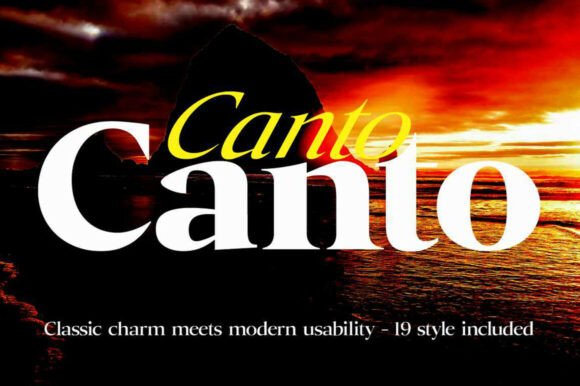
In the ever-evolving landscape of digital and print design, the choice of typography is far more than a mere aesthetic preference; it is a foundational decision that dictates the tone, readability, and authority of the final product. For designers seeking a typeface that bridges the gap between historical gravitas and contemporary utility, Canto emerges as a formidable solution. This monumental serif display font family is not simply a collection of letters but a comprehensive engineering toolkit designed to command attention while maintaining a sophisticated elegance.
The Challenge of Balancing Authority with Accessibility
Designers often face a specific dilemma when working on editorial layouts, branding, or environmental graphics: how to utilize a serif font that feels authoritative and "heavy" without sacrificing legibility or appearing outdated. Traditional serif fonts can sometimes feel too rigid for modern web interfaces, while overly geometric sans-serifs may lack the warmth and trust associated with established institutions. The goal is often to find a typeface that possesses the structural integrity of classical architecture—think Roman inscriptions—while offering the flexibility required for today's fast-paced media consumption.
This is where the unique engineering of Canto addresses a critical need. Drawing deep structural inspiration from vintage editorial frameworks, Canto offers a heavy-weight presence that grounds a design. However, unlike static vintage fonts, it has been masterfully developed to function as a versatile production kit. It solves the problem of limited variability by providing an expansive library of 19 styles within a single family package. This allows designers to maintain brand consistency across massive projects—from a tiny footnote in a magazine to a billboard advertisement—without needing to mix conflicting type families.
Practical Applications and Creative Fluidity
The practical utility of Canto lies in its ability to adapt to various contexts while retaining its core identity. Because the font draws on traditional geometry, it is particularly effective in scenarios where trust and permanence are paramount. Consider the following applications:
- Editorial and Publishing: The sharply chiseled serifs and bold stems make Canto an ideal candidate for magazine headers and book covers. It commands the canvas, ensuring that headlines catch the eye immediately. The availability of fluid, forward-slanting italics also allows for dynamic pull quotes that break the monotony of body text.
- Branding and Identity: For brands aiming to project an image of heritage, luxury, or stability, Canto provides the necessary weight. It works exceptionally well for law firms, financial institutions, or high-end fashion labels that want to evoke a sense of history without looking archaic.
- Environmental Graphics: When type needs to be legible from a distance—such as on signage or event backdrops—the ultra-bold weights of Canto ensure maximum visibility. The structural inspiration from Roman inscriptions means the letters are built to be recognized instantly, a crucial factor in wayfinding design.
Addressing Different User Needs
Different creative professionals will approach Canto with distinct objectives, and the font family is engineered to accommodate these varied workflows.
The Editorial Designer: For those working in layout design, the challenge is often managing hierarchy. With 19 styles available, a designer can use the heaviest weight for the main cover line, a medium weight for sub-headers, and a distinct italic style for captions. Canto allows for a complete creative fluidity that reduces the need for external assets, streamlining the design process.
The Brand Strategist: A strategist needs a typeface that is scalable. Canto functions as a powerhouse asset because it transitions seamlessly from print to digital. The "bold, authoritative stems" ensure that the brand voice remains consistent whether the logo is viewed on a mobile screen or a corporate letterhead.
The Web Designer: While Canto is a display font, its engineering allows for specific use in web environments, particularly in hero sections and landing pages where visual impact is the primary goal. By using Canto for key headers, a web designer can create a striking contrast against a sans-serif body font, improving the user experience by guiding the eye naturally through the content hierarchy.
Implementation and Recommendations
To maximize the potential of Canto, it is recommended to view the typeface not just as a decorative element, but as a structural framework. Here are a few considerations for implementation:
- Contrast is Key: Because Canto is a heavy-weight display font, it pairs best with lighter, highly legible sans-serif fonts for body copy. This contrast ensures that the "monumental" nature of Canto enhances the layout rather than overwhelming it.
- Spacing and Breathing Room: Given the bold geometry inspired by Roman structures, Canto benefits from generous tracking (letter-spacing) when used in all-caps headlines. This allows the "sharply chiseled serifs" to breathe and be appreciated individually.
- Leveraging the Full Family: Do not limit usage to just the standard bold. Experiment with the 19 styles to find the specific nuance required for the project. The "vintage editorial framework" of the font means it has a rhythm; finding the right weight can set the tempo for the entire design.
Conclusion
Ultimately, Canto represents a synthesis of past and present. It offers the solution to the modern designer's need for a typeface that is both visually impactful and technically robust. By integrating the discipline of traditional geometry with the flexibility of a modern production kit, Canto empowers creatives to produce work that is not only beautiful but structurally sound and deeply resonant. Whether the goal is to evoke the permanence of stone or the fluidity of ink, Canto