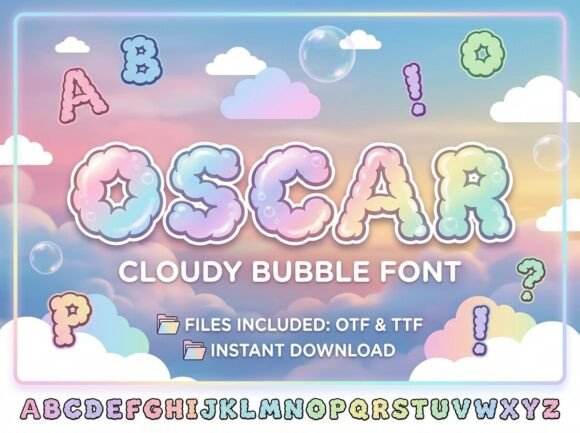
Oscar: The Anatomy of a Whimsical Cloudy Bubble Font
The Visual Language of Softness and Play
In the landscape of graphic design, typography is rarely just about legibility; it is about evoking an immediate emotional response. Oscar, a whimsical Cloudy Bubble font, operates on this principle by utilizing visual cues that trigger associations with comfort, childhood, and dreams. The design philosophy behind Oscar is rooted in the concept of "soft geometry." Unlike sharp, sans-serif fonts that demand attention through authority, Oscar invites the viewer in through warmth. The characters are constructed to resemble fluffy, multi-colored clouds, but with a structural integrity that ensures they function as readable text rather than abstract art.
The defining characteristic of this font family is its texture. Each letterform in Oscar mimics the ephemeral nature of a summer sky. The designers achieved this by softening the harsh curves typically found in bubble fonts. Instead of perfectly circular shapes, the letters feature organic, slightly irregular outlines that suggest the movement of air. This creates a dynamic feel, as if the letters might float away on a breeze if not anchored to the page. The "bubble" aspect is not merely spherical; it refers to the translucency and volume within the letterforms. By integrating tiny bubble accents into the negative space of the characters, the font gains a playful depth that distinguishes it from standard rounded typefaces.
Chromatic Theory and Pastel Gradients
Color is inextricably linked to the identity of Oscar. A cloud is never truly a single flat color; it is a canvas for light, shifting from brilliant white to deep grey, or during sunrise, a spectrum of pinks and oranges. Oscar translates this phenomenon into a digital format through its signature dreamy pastel gradient. This technique moves away from monochromatic fills, utilizing a blend of colors that transition smoothly across the x-height and cap-height of the letters.
From a color theory perspective, the palette used in Oscar is designed to lower visual stress. Pastel colors—soft lavenders, mint greens, baby pinks, and sky blues—have lower saturation levels. This makes them ideal for prolonged viewing, which is essential for branding materials that a consumer might look at repeatedly, such as product packaging or a website header. The gradient effect adds a three-dimensional quality, suggesting that the letters are illuminated by a light source, much like clouds catching the sun. This chromatic complexity allows the font to stand out against both white backgrounds and muted, solid-colored backdrops, providing versatility in layout design.
Strategic Applications in Modern Branding
While Oscar possesses a distinct personality, its utility spans a surprising variety of industries. The font is not limited to juvenile applications; it is a strategic tool for any brand aiming to communicate approachability and gentleness.
Nursery Decor and Interior Design:
In the realm of interior design, specifically for children's spaces, typography often appears on wall art, growth charts, and custom decals. Oscar’s multi-colored nature allows designers to create wall art that acts as a focal point without requiring additional illustration. The letters themselves serve as the art. The pastel gradients blend seamlessly with common nursery color schemes, such as Scandi-neutral or rainbow-themed rooms.
Children’s Apparel and Kawaii Stationery:
For the apparel market, particularly in the "Kawaii" (cute) inspired sector, the aesthetic of the product is paramount. Oscar aligns perfectly with the Japanese aesthetic of cuteness, which values roundness and softness. It is highly effective for screen printing on cotton t-shirts and tote bags. In stationery, where the tactile experience is important, the visual "fluffiness" of the font complements the physical texture of paper and stickers. It creates a cohesive sensory experience that appeals to hobbyists and scrapbookers.
Digital Media and UI Elements:
In the digital space, social media managers often struggle to find fonts that are readable on small mobile screens while still conveying a specific tone. Oscar’s bold weight and distinct outline make it legible even at smaller sizes on Instagram stories or TikTok overlays. It is particularly effective for "Quote of the Day" graphics, where the typography needs to carry the emotional weight of the message. The playful outline draws the eye, increasing engagement rates for content focused on mental health, self-care, or lighthearted humor.
Technical Considerations for Implementation
For graphic designers and developers, utilizing a font like Oscar requires an understanding of its technical constraints and strengths. Because it is a display font characterized by thick strokes and intricate bubble accents, it is not suitable for body text. The "bubbles" and gradients can create visual noise when scaled down to 12-point text, leading to legibility issues and "muddy" printing.
However, as a headline font, Oscar excels. When implementing this font in web design, it is crucial to consider file size and rendering. Highly detailed fonts can sometimes cause slight delays in load times if not optimized. Furthermore, the playful outline requires adequate spacing (kerning and tracking). If the letters are placed too close together, the outlines may merge, destroying the distinct cloud-like separation between characters. Designers should increase tracking by 5-10% to ensure each letter maintains its individual silhouette.
Another technical aspect to consider is contrast. Because Oscar features a pastel gradient, it naturally has a lower contrast ratio against light backgrounds compared to a black sans-serif font. To ensure accessibility and readability, it is best practice to place Oscar on a dark, solid background or a background that contrasts sharply with the pastel palette, such as a deep navy or charcoal grey. This ensures that the "dreamy" aesthetic does not compromise the message's clarity.
The Psychology of Whimsy in Communication
Why does a font like Oscar resonate with such a broad audience, including professionals and educators? The answer lies in the psychology of "whimsy." In a high-pressure digital environment, visual elements that suggest softness and play can act as a psychological palate cleanser. For educators, using a font like Oscar for headers on a syllabus or classroom bulletin board can signal to students that the learning environment is supportive and low-stress.
For business owners, particularly in the wellness or lifestyle sectors, the font communicates a brand promise of care. It suggests that the product or service will be gentle, soothing, and non-aggressive. This is a powerful non-verbal cue. When a consumer sees the fluffy, multi-colored typography of Oscar, they subconsciously associate the brand with positive, comforting emotions before they even read the accompanying text.
Trends and the Future of Expressive Typography
The popularity of Oscar reflects a broader trend in design known as "Neo-Skeuomorphism" or "Claymorphism," where flat design is abandoned in favor of textures that mimic real-world, tactile objects. We are seeing a move away from rigid, corporate minimalism toward a more expressive, human-centric digital aesthetic. Fonts that look hand-crafted, organic, or natural are gaining traction because they counteract the sterility of algorithms and AI-generated content.
In the coming years, we can expect to see fonts like Oscar evolving with technology. Variable font technology may eventually allow users to adjust the "fluffiness" or the "bubble density" of the letters via sliders, offering even more customization. For now, Oscar stands as a testament to the power of personality in typography. It proves that a font can be more than a vessel for words; it can be an atmosphere, a mood, and a visual experience that lifts the spirit of the viewer.
Conclusion of Characteristics
To summarize the utility of this typeface, we can look at its core strengths through a practical lens:
- Visual Impact: High impact for headers and branding due to the unique gradient and outline.
- Emotional Resonance: Strongly associated with positivity, childhood, and comfort.
- Versatility: Applicable across print (apparel, stationery) and digital (social media, web) platforms.
- Aesthetic Alignment: Fits perfectly within Kawaii, Pastel, and Whimsical design trends.
By understanding the construction and intent behind Oscar, creators can harness its potential to build connections with their audience. Whether used for a bakery logo, a child’s birthday invitation, or a motivational poster, the font delivers a consistent message: that design can be soft, inviting, and full of imagination.