Creative Children: Evaluating the Handcrafted Appeal of a Stitched Display Font
Understanding the Distinctive Aesthetic
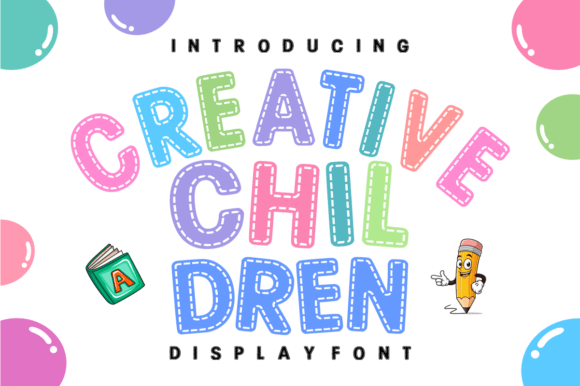
When selecting typography for family-oriented projects, the goal is often to balance visual appeal with clarity. Creative Children is a display font that occupies a specific niche within this category. At first glance, it presents as a bold, rounded sans-serif, but its defining characteristic lies in the internal structure of the letterforms. The font features a distinct dotted or dashed line running through the center of each stroke, effectively mimicking the appearance of embroidery, stitching, or perforated patterns found on sewing cards.
This design choice distinguishes Creative Children from standard "cute" fonts, which often rely solely on irregular baselines or exaggerated curves to convey playfulness. Instead, this typeface relies on texture to evoke a specific tactile sensation—the feeling of fabric, yarn, or handmade crafts. For designers working on projects that require a "maker" aesthetic without the complexity of using actual stitch brushes or effects, this font offers a streamlined solution.
Analyzing Legibility and Visual Weight
The primary tradeoff with highly decorative fonts is often legibility. However, Creative Children mitigates this risk through its structural choices. The base letterforms are bold and possess a wide stance. By using a dotted internal line rather than a solid fill, the font reduces the visual weight of the characters, preventing them from looking like heavy, dark blocks. This makes it surprisingly readable at medium-to-large sizes, even when used for shorter sentences or headlines.
It is important to evaluate the size at which the font will be displayed. Because the "stitching" effect relies on small gaps within the stroke, rendering this font at very small sizes (such as body text under 12pt) will likely cause the dots to blur or disappear, leaving the text looking jagged or unclear. Therefore, when comparing this to standard sans-serifs or simple rounded fonts, Creative Children should be viewed strictly as a display or headline typeface intended for high-impact visibility.
Practical Applications in Physical Production
For the audience utilizing cutting machines like Cricut or Silhouette, the utility of a font extends beyond how it looks on a screen; it must translate effectively to vinyl, cardstock, or heat transfer material. Creative Children is designed with this workflow in mind. The letterforms are spaced to allow for easy "weeding"—the process of removing excess material from a cut design.
Unlike script fonts with intricate swashes that can tear, or ultra-thin sans-serifs that are difficult to peel, the bold, rounded shapes of this font are robust. The internal stitched detail is typically cut as a negative space or a separate layer, depending on the software settings, allowing for creative material layering. For instance, one could cut the base shape in felt and the internal stitches in a contrasting thread color or vinyl. This versatility makes it a practical choice for custom apparel, tote bags, and nursery decor where durability and production speed are factors.
Comparison with Alternative Typography Styles
When researching options for child-centric branding or event stationery, you will encounter several distinct categories. Understanding where Creative Children fits within this landscape helps in making an informed decision.
- Standard Rounded Sans-Serifs: Fonts like Varela Round or Comfortaa offer high legibility and a friendly feel. They are excellent for body text but lack the thematic "texture" of Creative Children. If your project is text-heavy, a standard rounded font is safer; if it requires a strong visual theme, the stitched font is superior.
- Handwritten/Script Fonts: Cursive fonts mimic penmanship. While personal, they can be difficult for young children to decode. Creative Children maintains the structure of printed letters, making it more accessible to early readers while retaining a handmade vibe.
- Chunky Block Fonts: These are often used for impact but can feel aggressive or industrial. The stitching effect in Creative Children softens the boldness, creating a "cozy" rather than "loud" atmosphere.
Ideal Use Cases and Scenarios
Determining the "best" font requires matching the tool to the specific context of the project. Creative Children excels in scenarios where the theme revolves around crafting, education, domesticity, or comfort.
- Nursery and Classroom Decor: The font pairs well with themes involving animals, nature, or learning supplies. It complements illustrations of pencils, scissors, and yarn balls.
- Teacher Resources: For bulletin board headers, flashcards, or worksheet titles, the font signals a friendly, approachable learning environment.
- Seasonal Crafts: It is particularly effective for autumn and winter projects where textures like knitting and quilting are culturally relevant.
- Apparel Design: For t-shirts or hoodies aimed at parents, teachers, or children, the font stands out without requiring complex graphic overlays.
Evaluating Limitations and Alternatives
No single typeface is universal. There are distinct limitations to consider before committing to Creative Children. As noted, it is not suitable for long-form reading. Furthermore, the specific "stitched" style may clash with modern, minimalist, or corporate aesthetics. If your brand identity is sleek and geometric, this font will feel out of place.
Additionally, the decorative nature of the font means it has a lower "replay value" for diverse projects. A simple geometric font can be used for a wedding invitation, a tech startup, and a bakery. Creative Children is semantically locked to a specific genre of warmth and childhood.
If you require a font that looks handmade but prefer a cleaner look without the internal stitching details, you might explore fonts with slightly irregular edges or "wobbly" baselines. Conversely, if you want to lean even harder into the textile theme, you might look for fonts that simulate cross-stitch (using X shapes) rather than running stitches.
Decision Factors for Designers
When comparing Creative Children against other resources in your library, ask the following questions:
- What is the material? If you are cutting vinyl, the bold strokes are a plus. If you are screen printing, ensure your mesh count can handle the dotted details.
- Who is the audience? For toddlers, the shapes are engaging. For teenagers, the style might feel too juvenile.
- What is the medium? On digital screens, the font renders cleanly. On very rough textured paper, the small dots might get lost in the paper grain.
Ultimately, Creative Children